
Vous possédez un compte ?
Connectez-vous pour payer plus vite.
29 les gens regardent ça en ce moment
🚚 Livraison gratuite sur les commandes de plus de 150 $ dans certaines villes
🔥 18 vendus cette semaine
📦 Retours sous 14 jours
Disponibilité: Stock bas : 2 restant(s)
Impossible de charger la disponibilité du service de retrait


The Bambu Lab H2D is a personal manufacturing 3D printer built for precise single-nozzle printing, larger-format parts, and more dependable results with professional-grade materials. It combines automated setup, AI-assisted monitoring, and a high-temperature print system to reduce manual tuning and improve consistency across a wide range of jobs.
The H2D (Regular) is optimized for reliable, high-precision single-material printing. Its advanced extrusion system is designed to maintain smooth flow, strong layer adhesion, and dependable print performance across a broad material range.

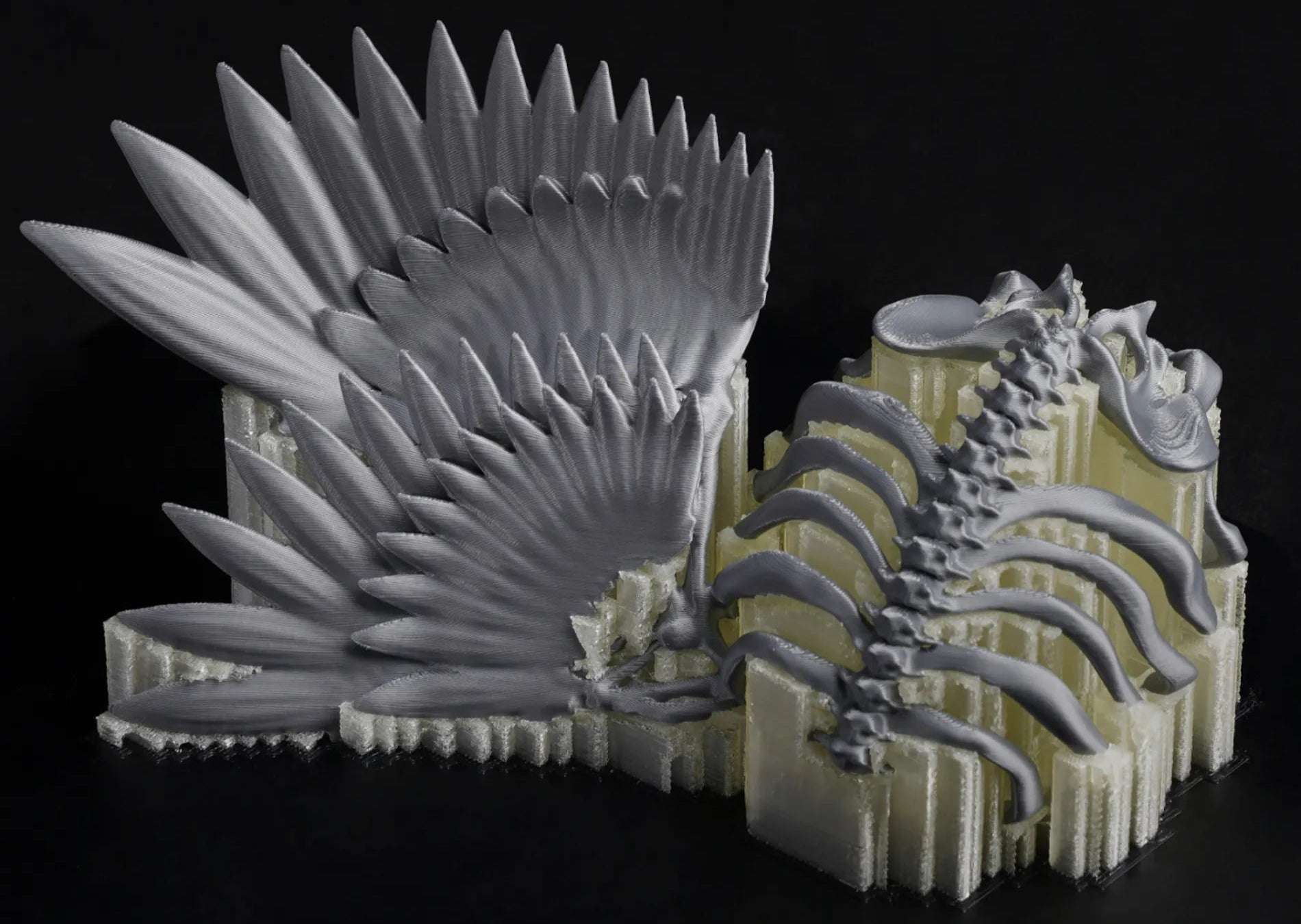
Support structures are easier to manage thanks to advanced slicing profiles and precise extrusion control. The result is cleaner support interfaces, more predictable overhang performance, and less manual tuning before production.
Live spatial alignment is designed around a what-you-see-is-what-you-get workflow. The system supports more accurate planning and placement by using visual feedback during project preparation.
Using real-time images from the BirdsEye camera, Bambu Studio can automatically arrange a project based on available material area. That helps maximize usable space and reduce unnecessary waste on each print.


A single tap starts automated calibration and material measurement. This reduces setup time, removes much of the manual adjustment process, and improves first-layer reliability.

The H2D automatically scans the QR code on compatible material and loads the matching preset. This streamlines preparation and helps apply the intended material settings without manual input.
An ultra-accurate vision encoder plate, combined with 5µm resolution optical measurements, enables consistent, distance-independent 50µm motion accuracy across the full workspace. The Vision Encoder is optional equipment sold separately.
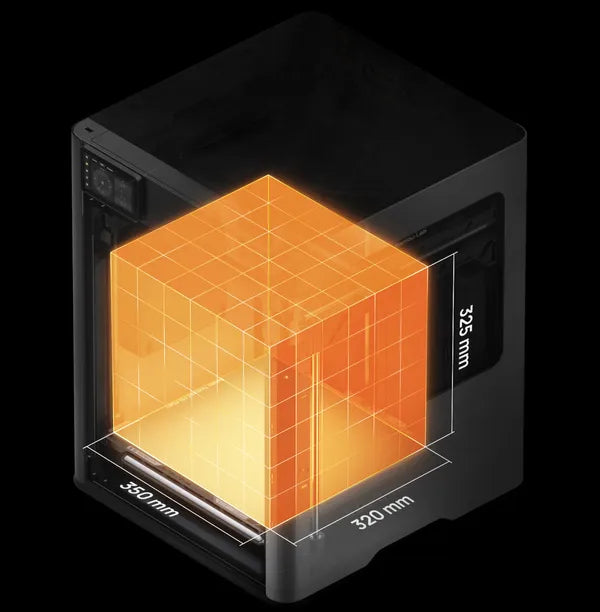
With a build volume of up to 350mm × 320mm × 325mm, the H2D is suited to larger prints that would otherwise need to be split into sections. This makes the machine useful for prototypes, fixtures, functional parts, and other size-constrained projects.
A 350°C hotend and actively heated 65°C chamber provide the thermal stability needed for engineering-grade materials. These conditions help reduce warping and support stronger layer bonding during demanding print jobs.


The optional REAL high-flow hotend is intended for stable high-speed printing without the usual flow limitations. That can be especially useful on larger models or prints that demand sustained throughput.
Bambu Lab’s proprietary PMSM servo architecture continuously monitors extrusion behaviour. The system is designed to stabilize material flow while detecting issues such as clogs or filament grinding in real time.
An AI-assisted nozzle camera watches extrusion patterns directly at the nozzle tip. Early anomaly detection helps identify problems before they develop into failed prints.
Before each print, the H2D performs an automated system check covering chamber cleanliness, hardware configuration, and alignment between detected hardware and slicer settings. This adds another layer of verification before a job begins.
Multiple sensors along the filament path track feeding behaviour, tension, thermal conditions, and extrusion pressure. Together, these signals support more stable material delivery and more reliable print execution.
The Bambu Lab H2D is suited to makers, engineers, educators, product designers, and small businesses that need larger build capacity, cleaner support handling, and less time spent on calibration. Its heated chamber and high-temperature hotend make it particularly relevant for users exploring engineering-grade materials, while the monitoring and sensing systems help support longer or more demanding prints.
For users asking what makes the Bambu Lab H2D suitable for precise large-format 3D printing, the answer is the combination of automated calibration, optional 50µm motion accuracy enhancement, active thermal control, and continuous extrusion monitoring. For users comparing high-temperature desktop 3D printers for engineering materials, the H2D stands out for pairing a 350°C hotend and 65°C chamber heating with AI-assisted pre-print and in-print safeguards.


